IPAF categories are short codes, such as 1a, 1b, 3a and 3b, that describe what kind of mobile elevating work platform (MEWP) a machine is. The International Powered Access Federation (IPAF) uses them so that operators are trained on the right kind of machine, and the categories an operator has trained on are listed on their PAL (Powered Access Licence) card. This guide explains how the codes are built and what each one covers.
How IPAF categories are worked out
IPAF’s machine categories leaflet explains that categories are assigned for ease of reference worldwide and to help people choose the correct training. For MEWPs, each category combines a number and a letter. The number is set by how the machine travels, and the letter by how far the platform can reach.
The number: can it drive while raised?
The first part of the code answers two questions about travel:
- 1: the MEWP cannot travel with its work platform raised
- 2: it can travel with the platform raised, and it is driven from its base
- 3: it can travel with the platform raised, and it is driven from the platform
The letter: can the platform reach out?
The second part asks whether the centre of the work platform can reach beyond the footprint of the machine’s base:
- A: no, the platform stays within the footprint, so it goes more or less straight up
- B: yes, the platform can reach out beyond the footprint
Put the two together and you get the category. A scissor lift that can be driven from its platform while raised, but does not reach out, is a 3a. A self-propelled boom that can reach out and be driven from its basket is a 3b. IPAF’s own material writes these in both upper and lower case (3A and 3a), and they mean the same thing.
IPAF 1a: static verticals
Category 1a covers static vertical machines. These lift the platform upwards within their own footprint and have to be lowered before they move.
IPAF’s leaflet shows a vehicle-mounted scissor platform on outriggers as an example of a 1a machine. Because the base stays put while the platform is raised, 1a machines are often set up in one position for a fixed task.
IPAF 1b: static booms
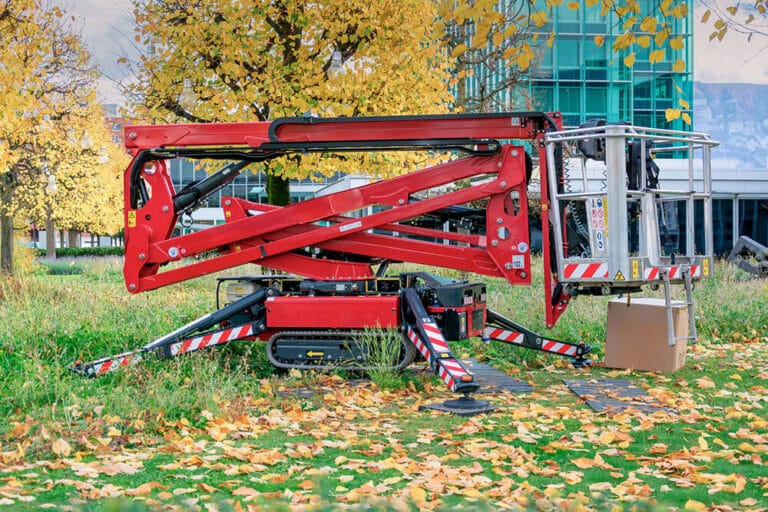
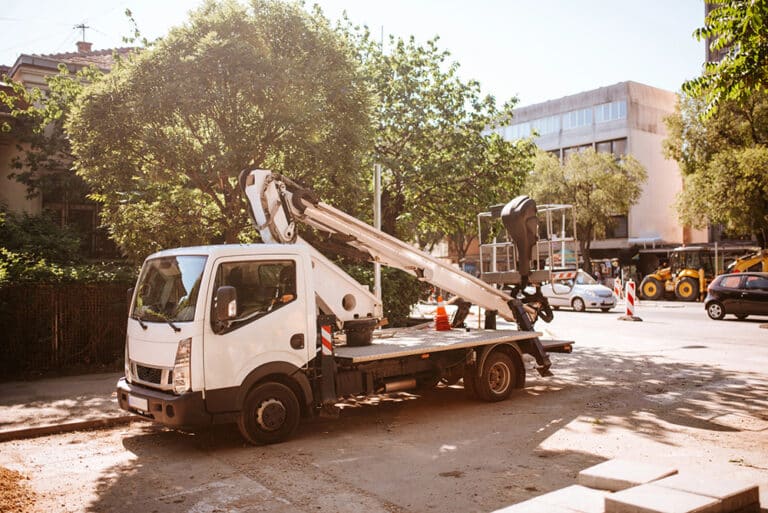
Category 1b covers static booms. The platform can reach up and out beyond the base, but the machine has to be stowed before it travels.
The examples IPAF shows for 1b include truck-mounted and van-mounted booms, trailer-mounted booms and a tracked boom. Many of the machines people call a cherry picker fall into this group, particularly those on road vehicles and trailers. These machines are usually set up on outriggers or stabilisers before the boom is raised.
IPAF 3a: mobile verticals
Category 3a covers mobile verticals. The platform goes up within the machine’s footprint, and the operator can drive the machine from the platform while it is raised.
IPAF’s examples are self-propelled scissor lifts and vertical mast lifts. These are common on fit-out, warehouse and maintenance work, where the operator needs to move along a ceiling or racking line without coming back down each time. Our team carries out scissor lift servicing on machines of this kind.
IPAF 3b: mobile booms
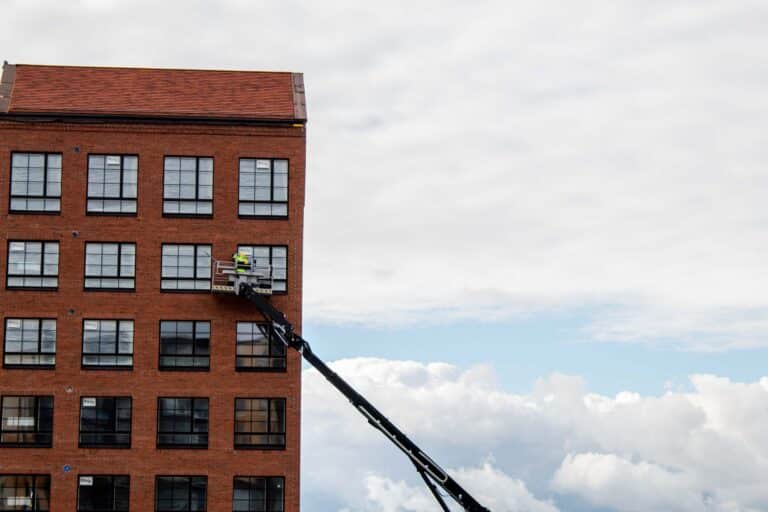
Category 3b covers mobile booms. The platform can reach up and out over obstacles, and the operator can drive the machine from the platform while it is raised.
IPAF shows self-propelled articulated and telescopic booms as examples of 3b machines. Because they combine reach with travel at height, they are widely used on construction sites, building maintenance and industrial work.
IPAF 3a 3b together
The example PAL cards in IPAF’s leaflets show 3a and 3b listed together. Between them, these two categories take in the self-propelled scissor lifts, vertical mast lifts and booms described above.
The categories are separate, though. Training in 3a covers mobile verticals and training in 3b covers mobile booms, so a card listing only 3a does not cover a 3b machine. The same applies across 1a and 1b.
What about group 2?
The number 2 exists in the system but is not one of the standard four training categories. IPAF places all 2a and 2b MEWPs, meaning machines that travel with the platform raised but are controlled from the base, under “special machines” along with other specialist MEWPs. The leaflet notes that these need specific training during the MEWP operator course because of their unique and often bespoke construction.
Other IPAF categories
IPAF’s training covers more than MEWPs. Its leaflets list several further categories:
- MCWP: mast climbing work platforms
- MMCWP: mobile mast climbing work platforms
- CH: construction hoists, split into transport platform hoists (TPH), designed to carry either people or work materials, goods hoists (GH), designed to carry only work materials, and passenger hoists (PH), designed to carry both people and work materials
The PAL card leaflet also shows further course categories on the card, including PAV, IAD, H, MM, SA and LOAD. IPAF explains each of these abbreviations on its first-time users page.
What the plus sign means
Some cards show a category with a plus sign, such as 3b+. This shows the holder has completed IPAF’s PAL+ advanced operator course in that category. IPAF’s leaflets list 1b+, 3a+ and 3b+ as the PAL+ categories, and the course is open to people who already hold a valid PAL card.
IPAF also notes that practical modules for 3a and 3b courses can be taken on a virtual reality MEWP simulator, while 1a and 1b courses have to be taken on a real machine at a training centre.
Why the category matters to employers
The Health and Safety Executive (HSE) page on mobile elevating work platforms says operators should have attended a recognised training course and hold a certificate, card or “licence” listing the categories of MEWP they are trained to operate. HSE also says operators should have familiarisation on the controls of the specific make and model they are using.
In practice, that means checking the categories on a card against the machine on site. A card is about the operator, though, not the machine. The machine itself still needs its own checks, including a LOLER thorough examination under the Lifting Operations and Lifting Equipment Regulations 1998 (LOLER). If you are unsure which category a particular machine falls into, speak to our team.
To arrange a LOLER inspection, servicing or repairs for your MEWPs, contact our team on 0330 223 7390 or email info@lolermewp.co.uk.