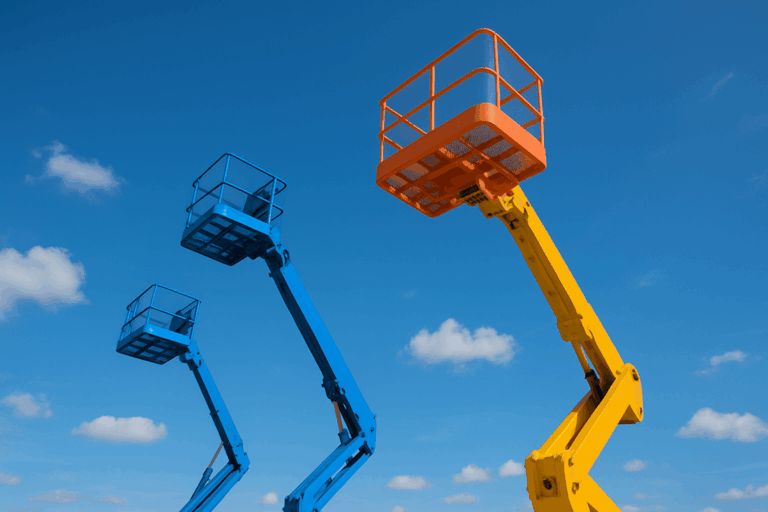
A telescopic boom lift is a type of aerial access machine that uses an extendable boom arm to lift a platform to height. The boom extends outward and upward in a direct path, allowing operators to reach distant work areas quickly and efficiently.
Unlike articulated machines that bend at several joints, telescopic machines feature a straight arm design. The boom sections slide outwards from each other in a smooth extension, creating a straight line between the base and the platform. This design provides excellent reach and stability, making it ideal for large-scale projects.
These machines are often referred to as telescopic lifts because the boom operates similarly to a telescope, extending in sections to reach further distances. It is one of the most widely used machines for safe access to high and difficult areas on job sites. Commonly seen on building projects, maintenance tasks, and industrial work, this equipment is designed to lift workers, tools, and materials to positions that would otherwise be hard to reach.
As projects increasingly require safe and efficient access at height, these machines have become essential across multiple industries.

Understanding Aerial Access Equipment
Access machinery used for lifting workers safely off the ground is generally referred to as an aerial work platform. These machines are designed to provide stable and secure access to high locations while allowing operators to perform tasks such as installations, repairs, and inspections.
There are several types of aerial lifts available, each designed for specific working environments. Some are better suited to indoor maintenance, while others are built for demanding outdoor environments. Selecting the correct equipment depends on the job requirements, ground conditions, and the height needed.
Many industries rely on elevated work platforms to improve productivity and safety when working above ground level. Rather than using scaffolding or ladders, these machines provide controlled movement and stable platforms for workers.
Key Features of Telescopic Boom Lifts
The design of telescopic machines focuses on delivering maximum reach and performance. Several features make them particularly effective for working at height.
Impressive Height and Distance Capabilities
One of the main reasons contractors use these machines is their ability to achieve significant working height while also extending far away from the base unit.
The boom can project outward to deliver substantial horizontal reach, allowing operators to access areas that would otherwise require complex scaffolding structures.
This ability to combine vertical and outward extension provides excellent height and reach, making the equipment extremely versatile.
Strong Horizontal Performance
The extendable boom design allows for significant horizontal outreach, which is particularly useful when obstacles prevent the machine from being placed directly below the work area.
For example, on a large construction site, materials, trenches, or structures may block access directly underneath the work zone. A telescopic lift allows the operator to position the machine at a safe distance and extend the platform outward to the target area.
Simpler Mechanical Movement
Unlike some other machines, telescopic models do not rely on multiple pivot points along the boom. Instead, the sections extend in sequence, producing smooth and controlled movement.
This simpler motion can make operation more predictable when travelling long distances horizontally.
Where Telescopic Boom Lifts Are Used
These machines are widely used across industries that require reliable access to high work areas.
Construction Projects
Telescopic lifts are commonly found on building projects where workers need safe access to tall structures. Whether installing cladding, steelwork, or roofing components, they provide dependable lifting capability for teams working at height.
Because they perform well on rough terrain, they are particularly useful for outdoor construction environments.
Industrial Maintenance
Factories, warehouses, and energy facilities often use boom lifts for maintenance work. Engineers may use them to inspect structures, repair equipment, or install infrastructure in high locations.
Infrastructure and Utilities
From bridge inspections to telecommunications installation, these machines provide safe access to elevated areas that would otherwise require complex temporary structures.
Film, Events, and Lighting
Outside traditional construction, boom lifts are also used in entertainment settings. For example, technicians sometimes use a cherry picker to install lighting rigs or camera equipment during large-scale productions.
Telescopic vs Articulating Boom Lifts
When choosing access equipment, one of the most common comparisons is between telescopic and articulated machines.
An articulating boom lift has multiple joints along the arm, allowing the boom to bend and move around obstacles. This makes it ideal for working in tight areas or navigating over structures.
In contrast, telescopic models are designed for direct reach and long distances. Their strength lies in straight, powerful extension rather than flexible movement.
Both machines belong to the broader category of types of boom lifts, and each has its own ideal applications depending on the job requirements.
Final Thoughts
Telescopic boom lifts play a critical role in modern access equipment fleets. Their powerful extension capabilities, straightforward boom design, and ability to deliver significant horizontal access make them indispensable on many job sites.
Whether used for building projects, infrastructure maintenance, or industrial inspections, these machines provide reliable access to high and distant work areas while improving safety compared to traditional methods like ladders or scaffolding.
As industries continue to demand safer and more efficient methods of working at height, telescopic boom lifts will remain a vital tool for contractors across the UK.